Project 32 Thermometer
Description
This project aims to design a simple Arduino smart thermometer using an LM35 temperature sensor and an LCD display. The LM35 sensor detects the ambient temperature, and the LCD displays the temperature value in real-time. This project serves as a great exercise for beginners, as it helps them understand the basic working principle of sensors and practice interaction between the display and sensor.
Hardware
1. 328 Plus development board x1
2. LM35 temperature sensor x1
3. 16x2 LCD display x1
4. resistors (220 ohms) x1
5. Breadboard x1
6. Jumper wires
Working Principle
The working principle of this project is as follows:
The LM35 temperature sensor detects the ambient temperature and converts it into a corresponding analog voltage signal.
The analog input pin of the Arduino development board (A0 in this case) reads the analog voltage output from the LM35.
The analog-to-digital converter (ADC) inside the Arduino converts the analog voltage value into a digital quantity.
Based on the conversion formula of the LM35 (where every 10mV corresponds to 1 degree Celsius), the Arduino converts the digital quantity into a temperature value.
The Arduino then displays the computed temperature value on the LCD1602 liquid crystal display.
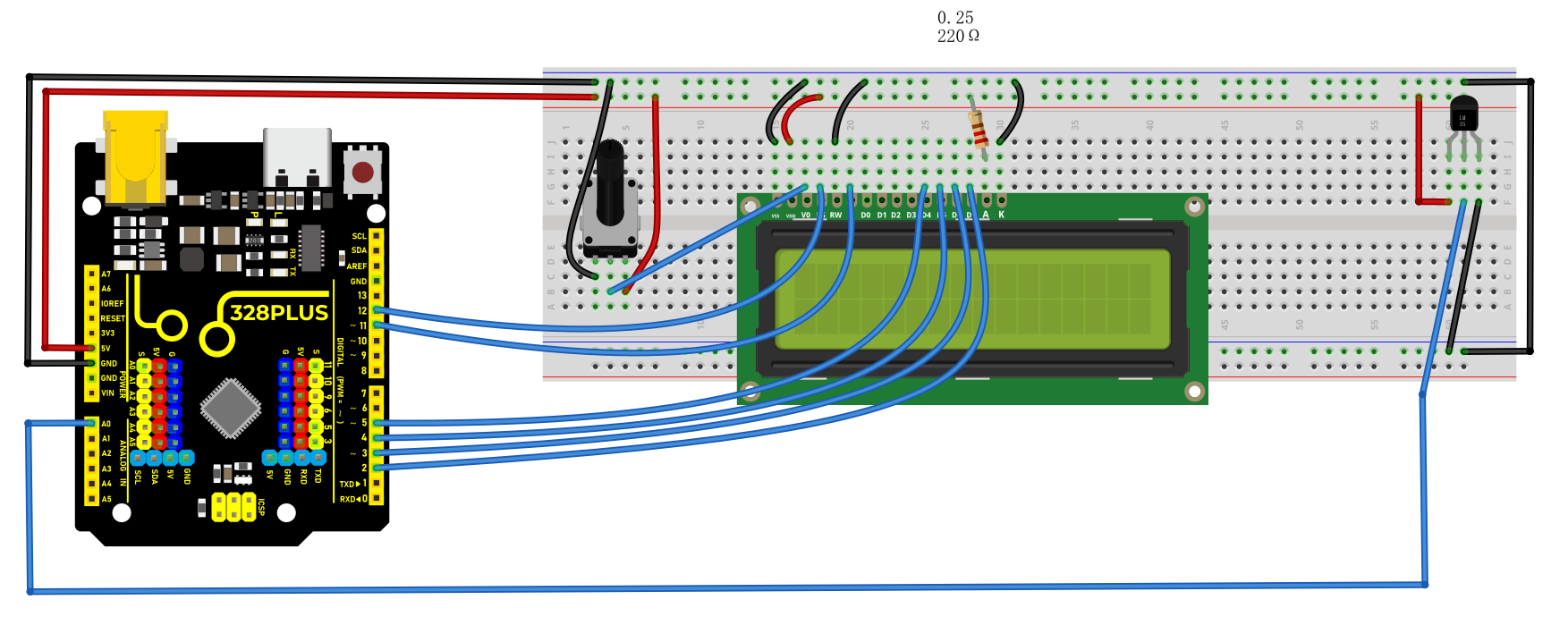
Wiring Diagram
LM35 Sensor
VCC: Arduino’s 5V
GND: Arduino’s GND
VOUT: A0 (analog input pin)
LCD1602
RS: Connect to digital pin 11
EN: Connect to digital pin 12
D4-D7: Connect to digital pins 5, 4, 3, 2, respectively
Sample Code
/*

Keye New RFID Starter Kit

Project 32

Thermometer

Edit By Keyes

*/

#include <LiquidCrystal.h>

// Initialize the GPIO pins: RS, E, D4, D5, D6, D7

LiquidCrystal lcd(12, 11, 5, 4, 3, 2);

const int sensorPin = A0; // LM35 connected to A0

void setup() {

// Set LCD column and row count

lcd.begin(16, 2);

// Display text on the first line

lcd.print("Temperature:");

}

void loop() {

// Read the analog value from LM35 (0-1023)

int sensorValue = analogRead(sensorPin);

// Convert the analog value to voltage (unit: mV)

float voltage = sensorValue * (5000.0 / 1023.0);

// Calculate the temperature value (unit: Celsius)

float temperatureC = voltage / 10.0;

// Display the temperature value on the LCD second line

lcd.setCursor(0, 1);

lcd.print(temperatureC);

lcd.print(" C ");

// Update every second

delay(1000);

}
Code Explanation
Library Inclusion and Initialization
#include <LiquidCrystal.h>

LiquidCrystal lcd(12, 11, 5, 4, 3, 2);

const int sensorPin = A0; // LM35 connected to A0
#include <LiquidCrystal.h>: Includes the LiquidCrystal library for LCD control.
LiquidCrystal lcd(...): Initializes the lcd object based on the LCD pin connections.
const int sensorPin = A0;: Defines the analog pin connecting the LM35 sensor as A0.
Setup Function setup()
void setup() {

lcd.begin(16, 2);

lcd.print("Temperature:");

}
lcd.begin(16, 2);: Sets the LCD to a 16-column and 2-row display mode.
lcd.print("Temperature:");: Displays “Temperature:” on the first line of the LCD.
Main Loop Function loop()
void loop() {

int sensorValue = analogRead(sensorPin);

float voltage = sensorValue * (5000.0 / 1023.0);

float temperatureC = voltage / 10.0;

lcd.setCursor(0, 1);

lcd.print(temperatureC);

lcd.print(" C ");

delay(1000);

}
Read Sensor Value
int sensorValue = analogRead(sensorPin);
analogRead(sensorPin): Reads the analog voltage value from the LM35 sensor, returning an integer between 0 and 1023.
Convert to Voltage
float voltage = sensorValue * (5000.0 / 1023.0);
Converts the sensor value to an actual voltage value in millivolts.
5000.0 accounts for Arduino’s 5V reference voltage, which is converted to 5000mV.
1023.0 is the maximum value of the ADC (10-bit ADC scale: 0-1023).
Calculate Temperature
float temperatureC = voltage / 10.0;
Given LM35’s specifications, every degree Celsius equals 10mV.
Thus, dividing the voltage by 10 yields the current temperature in Celsius.
Display Temperature on LCD
lcd.setCursor(0, 1);

lcd.print(temperatureC);

lcd.print(" C ");
lcd.setCursor(0, 1);: Moves the cursor to the second line, first column on the LCD.
lcd.print(temperatureC);: Displays the temperature value.
lcd.print(" C ");: Displays the Celsius symbol with spaces to cover any leftover characters.
Delay of One Second
delay(1000);
Delays for 1000 milliseconds (1 second) to control the update frequency.
Project Result
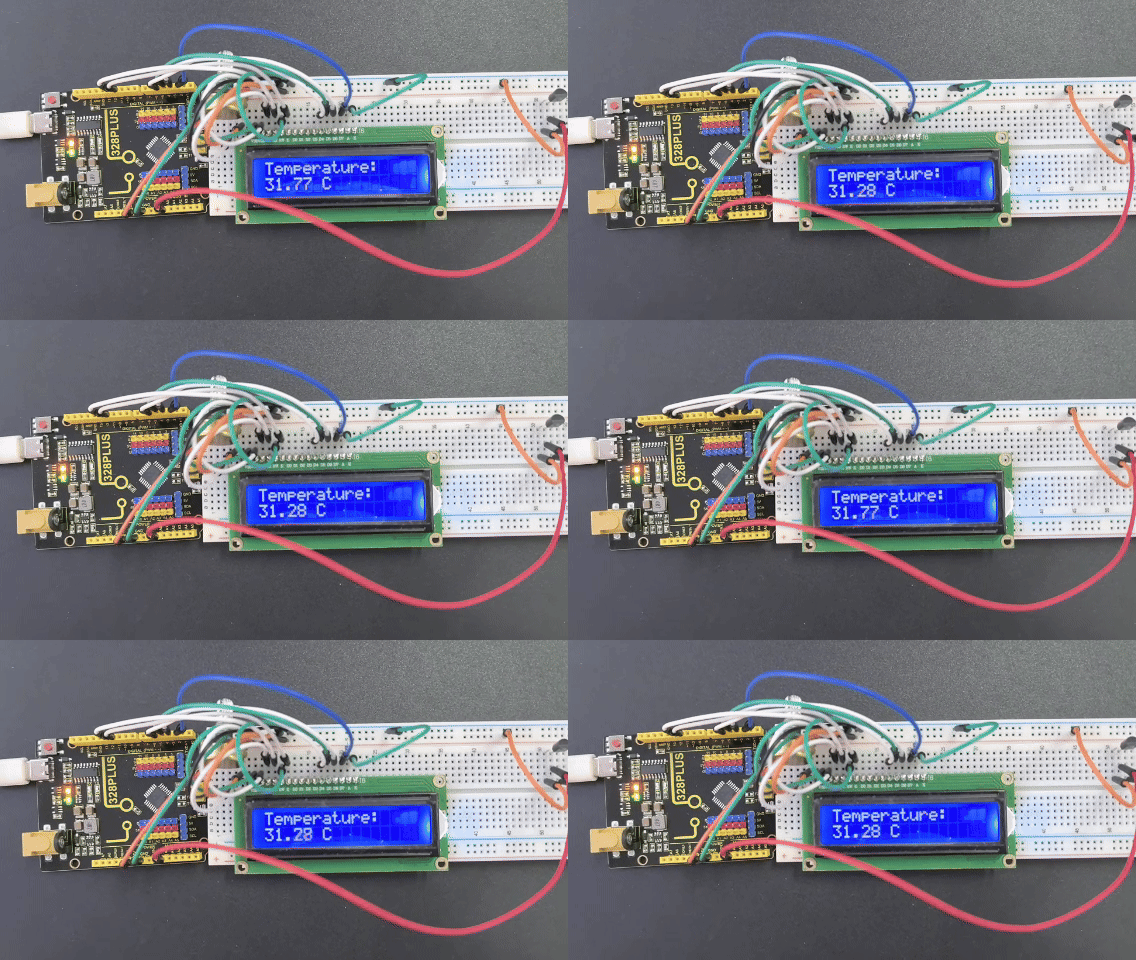
Upon completing this project, you will have a fully functional temperature tester. This device can display the ambient temperature in real time and provide visual feedback for temperature changes.